

Winrock International Concludes Transdisciplinary Conference 2026 under WISIONS Innovation Lab Project in Nepal
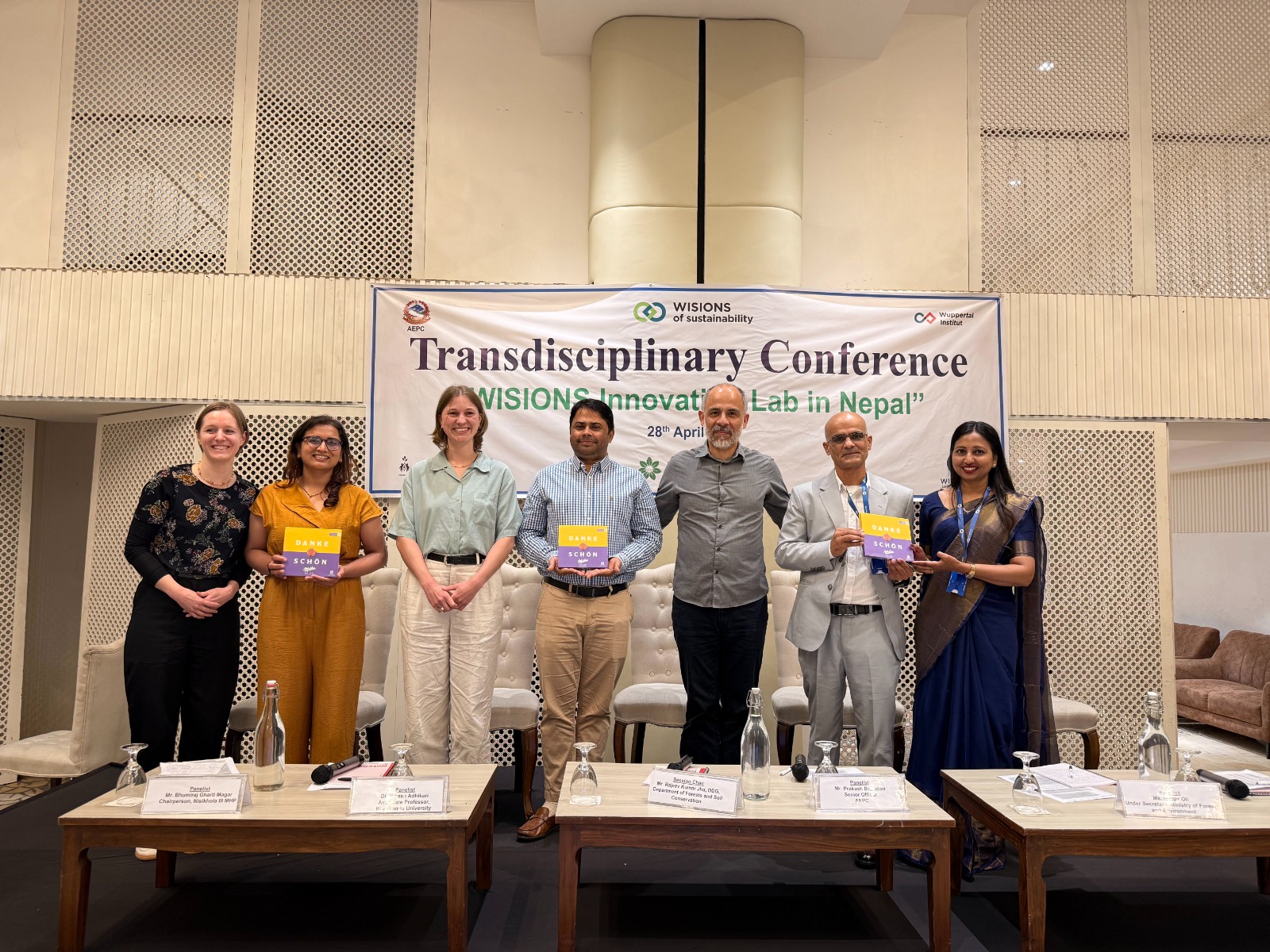 On April 28, 2026, stakeholders from across Nepal’s energy ecosystem and forestry sector gathered in Kathmandu for the Transdisciplinary Conference (TDC) under the WISIONS Innovation Lab in Nepal project implemented by Winrock International in partnership with PEEDA and RECOFTC Nepal.
The conference marked a significant milestone, bringing together government, private sector, development partners, banking and financial institutions, academia, and communities to reflect on almost four years of action research, innovation, and on-the-ground experiences across Baglung and Jumla districts. Structured around an inaugural session followed by three technical sessions, the event provided a comprehensive platform for sharing lessons, showcasing practical solutions, and exploring pathways for scaling decentralized and resilient energy systems in Nepal.
Importantly, the conference was designed as a transdisciplinary and highly interactive platform, facilitating meaningful dialogue across sectors. The high level of engagement between participants and panelists led to critical and constructive discussions, highlighting the value of such inclusive formats in enabling diverse stakeholders to exchange perspectives, challenge assumptions, and co-create pathways for future action.
Setting the Stage: From Systems Thinking to Action
The inaugural session set a strong foundation by emphasizing the need for integrated, system-based approaches to energy and development.
Opening remarks highlighted how the WISIONS Innovation Lab has gone beyond energy access, examining the intersection of energy, livelihoods, landscapes, and governance.
Presentations from Winrock and WISIONS further showcased:
- The evolution of micro-hydro plants (MHPs) from isolated systems to grid-connected enterprises
- A transdisciplinary approach, combining stakeholder engagement, co-design, experimentation, and continuous learning
- Tangible impacts such as 40–50% revenue increases following grid interconnection in pilot MHPs
Speakers from AEPC, GIZ, and BEK reinforced that Nepal’s clean energy transition will depend on strong policy alignment, continued capacity building and private sector engagement, and sustained collaboration across government and communities. Similarly, the Chairperson of Badigad rural municipality highlighted how MHPs have transformed rural livelihoods and how grid interconnection is now unlocking improved reliability, financial sustainability, and expanded productive use.
Technical Session 1: The Future of Micro-Hydro
The discussions in Technical Session 1 highlighted that Nepal’s micro-hydro sector is entering a critical new phase of transformation. The panel bringing together representatives from Alternative Energy Promotion Centre (AEPC), Nepal Electricity Authority (NEA), GIZ, the National Micro Hydro User Society, private sector networks, and a local MHP operator offered a rich blend of policy, technical, and community-level perspectives. Panelists emphasized that grid interconnection is central to long-term sustainability, enabling better load management, improved reliability, and enhanced revenue generation for micro-hydro plants. At the same time, they acknowledged persistent barriers, including challenges related to technical standards, metering systems, procedural complexity, and tariff structures, which continue to slow down scale-up. There was also growing interest in adopting hybrid solutions, such as combining micro-hydro with solar and storage, to improve system efficiency and resilience.
The discussion further highlighted important financial and investment-related challenges. Panelists noted that while grid interconnection improves viability, uncertainties around return on investment, tariff mechanisms, and access to financing remain key constraints for scaling. Different perspectives emerged on appropriate business and ownership models, with community stakeholders emphasizing the importance of retaining local ownership of plants, while private sector actors highlighted the need for aggregation and new business models to attract investment and ensure financial sustainability.
Several issues remained open and require further deliberation. These include the appropriate tariff structure for grid-connected MHPs, the balance between community ownership and private sector participation, and the need to simplify administrative and technical procedures for grid interconnection. Overall, while a strong consensus emerged that micro-hydro must move beyond basic rural electrification and evolve into dynamic, grid-integrated energy systems that support local economies, the session also underscored that addressing these unresolved institutional, financial, and regulatory challenges will be critical for scaling up these models across Nepal.
Technical Session 2: Productive Energy Use for Decarbonization
During the second technical session, panelists from FCDO, AEPC, NEA, E-cooking Supplier, NMB Bank, E-mobility institutions, and technology providers discussed how energy becomes truly transformative when it is used productively. The discussion focused on two key areas: electric cooking and electric mobility, each with distinct opportunities and challenges.
Electric Cooking
Electric cooking was highlighted as a promising pathway to reduce dependence on LPG, while also delivering economic, health, and environmental benefits. Panelists noted increasing adoption in both households and small enterprises, demonstrating its potential for wider scaling.
However, the discussion also surfaced several critical and still unresolved issues. One of the major concerns raised was the perceived risk of peak demand surges with widespread adoption of electric cooking. While this concern remains influential in planning, it was noted that it is often based on simplified assumptions rather than detailed analysis of actual consumption patterns and evolving load dynamics.
This issue is closely linked to the question of distribution network readiness. A somewhat linear approach prioritizing network upgrades before promoting adoption was debated. Panelists suggested that a more co-evolutionary approach may be needed, where infrastructure improvement and e-cooking adoption progress simultaneously, informed by real-time learning and data.
Additionally, financing mechanisms and the role of banks remain unclear. While some models exist, there is no consistent or scalable framework yet for financing cooking appliances or supporting users, particularly in decentralized and rural contexts.
Electric Mobility
The discussion on e-mobility highlighted its rapid growth, including expansion beyond urban areas into rural corridors, supported by charging infrastructure and emerging business models. Panelists emphasized innovative solutions such as battery-swapping systems and cluster-based approaches, which are helping reduce investment risks and improve operational feasibility.
At the same time, the session revealed several areas of debate and uncertainty. These include questions about long-term financial viability, infrastructure deployment in low-demand areas, and coordination with grid capacity upgrades. There were also differing perspectives on the role of private sector versus public investment, and how risks should be distributed among stakeholders.
Overall, the session demonstrated that electric cooking and e-mobility offer promising pathways for decarbonization and productive energy use in MHP corridors, with ongoing learning and innovation continuously strengthening their potential for scale.
The overarching takeaway was clear: a just energy transition is not just about generating clean electricity, but about leveraging that energy to drive livelihoods, enterprises, and inclusive economic growth while simultaneously addressing the technical, financial, and institutional complexities that come with scaling these solutions.
Technical Session 3: Nature-Based Solutions for Resilience
The final technical session shifted the focus to climate resilience and environmental sustainability, bringing together perspectives from forestry, energy, academia, and local stakeholders. Panelists emphasized the critical role of bioengineering solutions in stabilizing slopes, preventing erosion, and safeguarding micro-hydro infrastructure in fragile mountain contexts. They highlighted that effective nature-based interventions must be site-specific and grounded in community knowledge and participation, rather than relying on generic approaches. The discussion also underscored the importance of integrating green and grey infrastructure to enhance long-term resilience.
A key reflection emerging from the session was the need for stronger integration of landscape and ecosystem considerations within the energy sector, particularly within the micro-hydro domain. While micro-hydro systems are often designed primarily from an engineering perspective, the discussions highlighted increasing recognition that landscape vulnerabilities such as erosion, landslides, and watershed degradation directly affect the performance and sustainability of these systems. At the same time, the design and placement of energy infrastructure can also influence the surrounding environment, underlining the importance of more holistic planning approaches.
This also brought forward an important question for future action: how responsibilities and investments for strengthening climate resilience should be shared among different stakeholders, including government agencies, local communities, and project developers.
Overall, the session reinforced that energy systems cannot be planned in isolation, they must be embedded within a broader ecosystem-based approach that simultaneously strengthens climate resilience, reduces infrastructure risks, and protects natural resources.
Looking Ahead: From Learning to Scaling
Nepal has already demonstrated promising approaches that are shaping the future of decentralized and integrated energy systems:
- Grid-connected micro-hydro systems
- Productive use applications like e-cooking and e-mobility
- Nature-based approaches for climate resilience
- Institutional innovations like inter-local government coordination
These experiences provide valuable insights and practical lessons. At the same time, they highlight the need for continued refinement, testing, and adaptation across different local contexts.
The next step is therefore not only to scale, but to carefully expand and deepen these approaches, strengthening evidence, adapting models, and embedding them within policy and institutional frameworks. Sustained collaboration across sectors will remain essential to support this ongoing learning and scaling process.
Conclusion
The Transdisciplinary Conference 2026 was more than a dissemination event, it was a convergence of evidence, experience, and diverse perspectives.
By bridging field-level innovation with national-level dialogue, the conference demonstrated that Nepal is not starting from scratch. Initiatives such as the WISIONS Innovation Lab have already generated important pilot experiences and new insights on how clean energy, landscape management, and livelihoods can be integrated into practice.
At the same time, these experiences underline that further learning, adaptation, and collaboration are needed to translate pilot-level progress into broader systemic change. Strengthening multi-stakeholder alliances, continued experimentation, and context-specific application will be critical to advancing these innovations.
Ultimately, the conference reaffirmed that moving from pilots to policy is not a linear process, but a continuous, collaborative journey, one that will be key to building a resilient, inclusive, and low-carbon future for Nepal.